Why Coding a Website Is Better Than Using a CMS
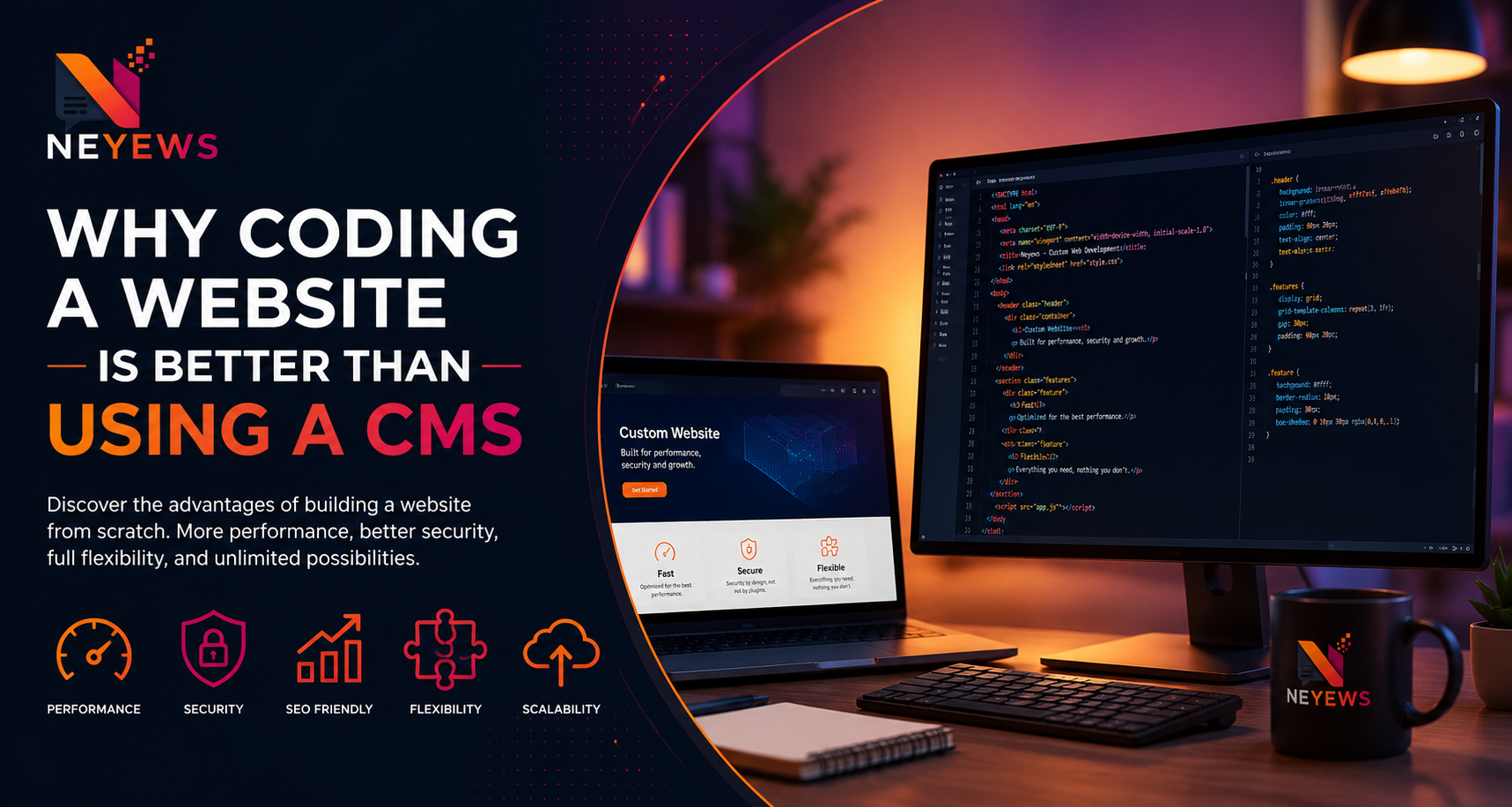
Discover why thousands of developers and businesses choose custom website development over content management systems. Learn how coding your own website can improve performance, security, SEO, flexibility, and long-term scalability.
Published: July 2026 | Category: Web Development
Table of Contents
Introduction
When creating a new website, one of the first decisions you will face is whether to build it from scratch using programming languages such as HTML, CSS, JavaScript, and PHP, or to use a Content Management System (CMS) like WordPress, Joomla, or Drupal. For many beginners, a CMS appears to be the easiest option. It offers ready-made themes, plugins, and a user-friendly dashboard that allows users to publish content without writing code. This convenience has made CMS platforms extremely popular for blogs, business websites, and personal portfolios. However, convenience often comes with compromises. As websites grow in complexity, issues such as slower loading times, plugin conflicts, security vulnerabilities, and limited customization can become significant challenges. Developers who require maximum performance, complete control, and the ability to create unique features frequently choose to build websites from the ground up. Custom coding gives developers full authority over every aspect of a website. Every line of code is written specifically for the project's requirements, eliminating unnecessary components and allowing the application to remain lightweight and efficient. This level of control is particularly valuable for web applications, online tools, e-commerce platforms, and software-as-a-service products where performance and scalability directly affect user experience. This article explores the major differences between custom-coded websites and CMS platforms. Rather than claiming that one approach is universally superior, we will examine the strengths and limitations of each so that you can make an informed decision based on your own goals.
Many of today's largest online platforms—including search engines, social media services, streaming platforms, and cloud applications—are powered by custom software rather than off-the-shelf CMS solutions. Their unique features, high performance, and ability to serve millions of users are made possible through tailored development designed specifically for their needs.
What is a CMS?
A Content Management System (CMS) is software that enables users to create, edit, and manage website content without writing much code. Instead of building each page manually, users work through an administration panel where they can publish articles, upload images, install themes, and extend functionality using plugins or modules. Popular CMS platforms include WordPress, Joomla, Drupal, Ghost, and several others. They are especially useful for small business websites, blogs, news portals, and organizations that need to update content regularly without relying on a web developer. One of the biggest strengths of a CMS is speed. A complete website can often be launched in a matter of hours by installing a theme and configuring a few plugins. This makes CMS platforms attractive for startups and individuals with limited technical knowledge. Despite these advantages, a CMS is designed to satisfy the needs of many different users. Because of this, it often contains features that your project may never use. These additional components can increase page size, create unnecessary database queries, and introduce dependencies that must be maintained throughout the life of the website.
What is a Custom-Coded Website?
A custom-coded website is built specifically for its intended purpose using programming languages such as HTML, CSS, JavaScript, PHP, Python, C#, or other technologies. Every feature, page, and database query is created to solve a particular problem instead of adapting a general-purpose platform. Unlike a CMS, there are no unnecessary plugins or features consuming server resources. The developer has complete freedom to design the user interface, optimize performance, implement security measures, and build unique functionality that perfectly matches the project's objectives. Custom development is commonly used for online banking systems, booking platforms, inventory management software, learning management systems, streaming services, enterprise applications, and advanced web tools. These applications often require specialized workflows that would be difficult—or inefficient—to implement using a traditional CMS. While building a website from scratch requires more development time and technical expertise, the long-term benefits often outweigh the initial investment for projects that demand speed, reliability, and complete flexibility.
1. Superior Website Performance
One of the most significant advantages of a custom-coded website is performance. Every visitor expects pages to load quickly, whether they are browsing from a desktop computer or a mobile phone. Slow websites frustrate users, reduce engagement, and can negatively influence search engine rankings. A custom website contains only the code required for its intended purpose. There are no unnecessary plugins, excessive scripts, or generic frameworks running behind the scenes. As a result, browsers download fewer resources, servers perform fewer database queries, and pages render more efficiently. In contrast, many CMS installations rely on multiple plugins to provide features such as contact forms, image galleries, SEO tools, analytics, caching, social media integration, and security. While each plugin may contribute useful functionality, together they can significantly increase page complexity and resource usage. A lean, well-designed custom application allows developers to optimize every component, resulting in faster loading times, lower memory consumption, and an improved experience for users across different devices and internet connections.
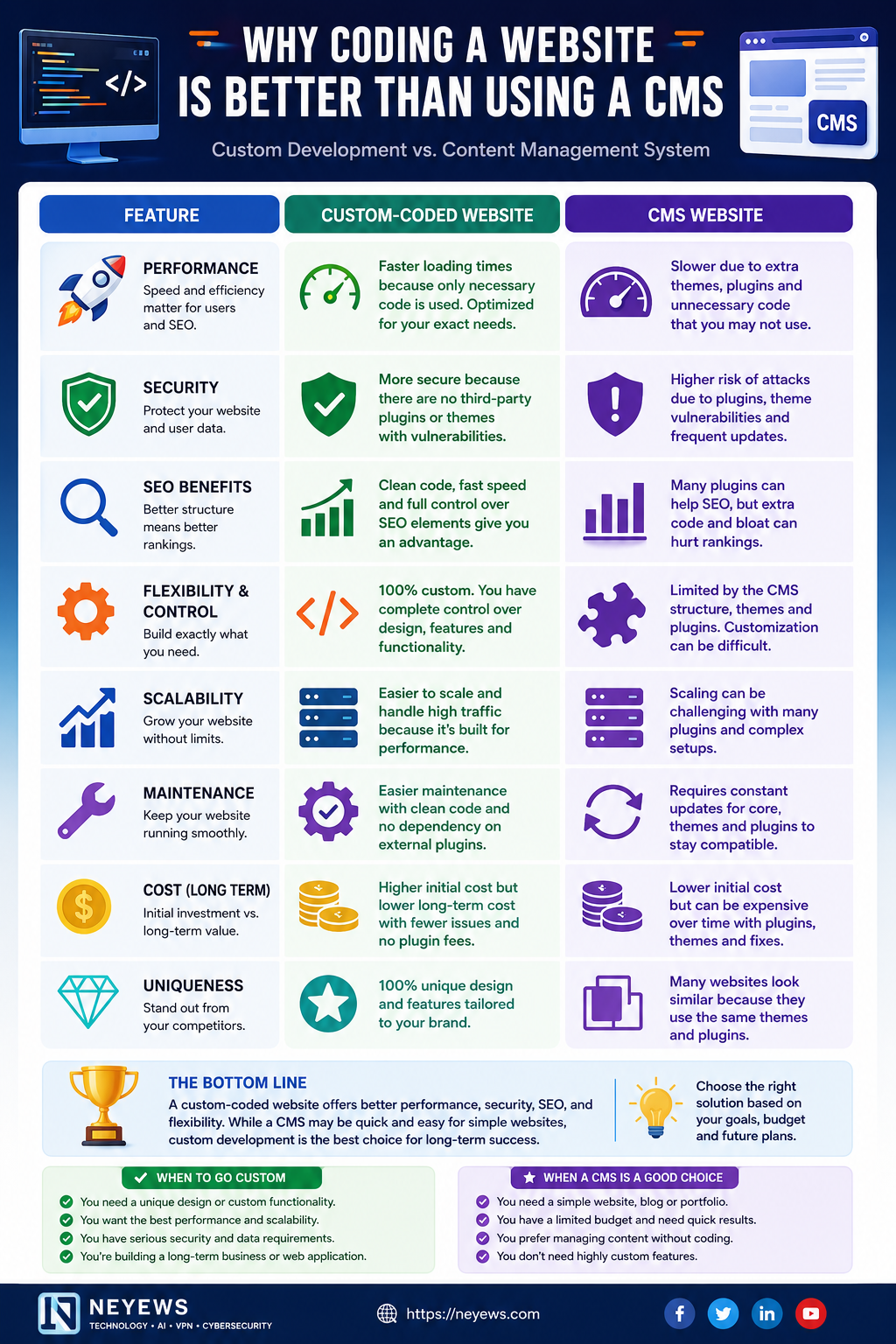
Infographic: Custom Website vs CMS
This infographic summarizes the key differences between a custom-coded website and a Content Management System (CMS). It highlights performance, security, SEO, flexibility, scalability, maintenance, cost, and the best use cases for each approach.
2. Better Website Security
Website security has become one of the most important considerations for businesses and developers. Every day, thousands of websites are targeted by automated bots searching for outdated software, weak passwords, and known vulnerabilities. One of the greatest advantages of a custom-coded website is that it contains only the code required for the application. There are no unnecessary plugins, unused themes, or third-party extensions that increase the attack surface. Most CMS platforms rely heavily on plugins to add features such as contact forms, SEO optimization, analytics, image galleries, backups, and social media integration. While many plugins are well maintained, every additional plugin introduces another component that must be updated and secured. Custom websites allow developers to implement security measures specifically designed for their application. Features such as secure authentication, prepared SQL statements, rate limiting, content security policies, and custom access controls can be built directly into the software without depending on third-party extensions. This does not mean that a CMS is inherently insecure. Well-maintained CMS installations can be very secure when updated regularly and configured properly. However, custom applications generally provide greater control over security because every component has been intentionally designed for the project.
3. Better SEO Opportunities
Search engine optimization plays a critical role in determining how easily users discover a website through search engines. Website speed, clean HTML, structured data, responsive design, and user experience all contribute to better rankings. Custom-coded websites give developers complete control over every SEO element. Developers can create clean URLs, semantic HTML, optimized metadata, structured Schema.org markup, Open Graph tags, XML sitemaps, canonical URLs, and internal linking strategies without depending on SEO plugins. Because custom websites typically contain less unnecessary code, pages often load faster. Faster websites generally provide a better user experience, especially on mobile devices. CMS platforms also offer excellent SEO capabilities through plugins, but they often generate additional HTML, CSS, and JavaScript that may not be required for a specific page. Removing unnecessary code becomes much easier when the website is built from scratch. A well-designed custom website allows every page to be optimized individually according to the needs of the content and target audience.
4. Unlimited Flexibility
Every business has unique requirements. While a CMS attempts to satisfy millions of different users, a custom website is built exclusively for one project. Developers are free to create completely original user interfaces, database structures, workflows, dashboards, reporting systems, and business logic without being constrained by the architecture of a CMS. For example, applications such as inventory management systems, customer portals, streaming platforms, booking systems, online learning platforms, and AI-powered web tools often require features that would be extremely difficult to implement using standard CMS plugins. Custom development allows every feature to be designed exactly as required without compromise.
5. Easier Scalability
As websites become more popular, they must be capable of handling increasing amounts of traffic without sacrificing performance. Custom applications are typically easier to optimize because developers have complete control over database queries, caching mechanisms, server-side processing, and API communication. Instead of relying on multiple plugins that may conflict with one another, developers can implement lightweight solutions specifically designed for their application's workload. This flexibility makes custom development particularly suitable for startups expecting rapid growth and businesses that process large amounts of data.
6. Easier Long-Term Maintenance
Many people assume that custom websites require significantly more maintenance than CMS platforms. In reality, the opposite is often true once the application has matured. CMS websites require frequent updates to the core software, themes, and plugins. Delaying updates may expose the website to security vulnerabilities, while installing updates immediately can occasionally introduce compatibility issues. Custom websites eliminate many of these concerns because there are no third-party plugins to maintain. Developers update only the features they actually use. This results in a cleaner codebase that is often easier to understand, debug, and improve over time.
Custom Website vs CMS Comparison
| Feature | Custom Website | CMS |
|---|---|---|
| Performance | ★★★★★ | ★★★☆☆ |
| Security | ★★★★★ | ★★★★☆ |
| Flexibility | ★★★★★ | ★★★☆☆ |
| Customization | ★★★★★ | ★★★☆☆ |
| Maintenance | ★★★★☆ | ★★★☆☆ |
| Initial Development Speed | ★★☆☆☆ | ★★★★★ |
| Long-Term Scalability | ★★★★★ | ★★★★☆ |
Which One Should You Choose?
Choose a custom-coded website if your project requires unique functionality, maximum performance, advanced security, or long-term scalability. Choose a CMS if you need a simple blog, company website, or portfolio that can be launched quickly with minimal development effort. The right choice depends on your budget, technical expertise, business goals, and future growth plans.
When a CMS Is the Better Choice
Although custom website development offers many advantages, it is not always the best solution for every project. A Content Management System can be an excellent choice when speed, simplicity, and ease of content management are more important than complete flexibility. For example, a small local business that only needs a homepage, services page, contact form, and blog can often launch much faster using a CMS. Website owners with little technical experience may also appreciate being able to edit content without writing code. Modern CMS platforms have evolved significantly over the years. With proper maintenance, reliable hosting, and carefully selected plugins, they can successfully power many professional websites. Ultimately, the best choice depends on your project's goals, available budget, technical expertise, and long-term plans.
Advantages and Disadvantages
| Custom Website | CMS Website |
|---|---|
| ✔ Faster performance | ✔ Faster to build |
| ✔ Maximum flexibility | ✔ Easy content editing |
| ✔ Better scalability | ✔ Thousands of themes |
| ✔ Better security control | ✔ Large community support |
| ✔ Unique design | ✔ Lower initial cost |
| ✖ Longer development time | ✖ Plugin dependency |
| ✖ Requires programming skills | ✖ Slower performance |
| ✖ Higher initial investment | ✖ More maintenance updates |
Frequently Asked Questions
Is WordPress bad?
No. WordPress is an excellent CMS that powers many successful websites. However, it may not be the best solution for projects requiring advanced custom functionality or maximum performance.
Can a custom website rank better on Google?
Yes, if it is properly optimized. Clean code, fast loading speeds, semantic HTML, and excellent user experience all contribute to strong SEO performance.
Does coding a website cost more?
Initial development usually costs more because every feature is built specifically for the project. However, long-term maintenance may be lower because there are fewer plugin dependencies.
Which option is more secure?
Both can be secure when implemented correctly. A custom website offers greater control over security because developers decide exactly which components are included.
Should beginners use a CMS?
If your goal is simply to publish a blog or business website quickly, a CMS is often the easiest starting point. If your goal is to become a web developer, learning HTML, CSS, JavaScript, and PHP is a valuable investment.
Final Thoughts
Choosing between a custom-coded website and a CMS is not about deciding which technology is universally superior. Instead, it is about selecting the solution that best supports your goals. If you need complete flexibility, high performance, advanced security, and the ability to build unique features, custom development is often the better long-term investment. If you need to publish content quickly, manage articles easily, and minimize development time, a CMS remains an excellent option. Successful websites are built by understanding user needs, creating valuable content, optimizing performance, and continuously improving the experience over time. Regardless of the technology you choose, focusing on quality, security, and usability will always produce better results.
Continue Learning Web Development
Interested in building faster, more secure websites? Explore our collection of tutorials covering HTML, CSS, JavaScript, PHP, Linux, Cybersecurity, Artificial Intelligence, VPN technology, and Search Engine Optimization here on Neyews.

About Neyews
Neyews publishes original articles covering technology, programming, cybersecurity, VPN services, Linux, Android, Artificial Intelligence, and Search Engine Optimization. Our goal is to make technology understandable for everyone while providing practical tutorials and in-depth guides.